



Main Article
From giant branded props and eye-catching retail displays to outdoor installations, fibreglass props can be found in all sorts of creative settings.
At Spur Creative, we've been creating bespoke props, models and sculptures since 2006. Fibreglass is one of the materials we regularly use (often alongside sculpted polystyrene) to bring our most ambitious ideas to life.
But what exactly are fibreglass props, and what makes fibreglass such a popular choice for professional prop makers?
What Are Fibreglass Props

Fibreglass props are three-dimensional objects made using glass fibres and resin to create a strong, relatively lightweight and durable structure. They're commonly used for retail displays, exhibitions, advertising campaigns, themed attractions and large-scale sculptures.

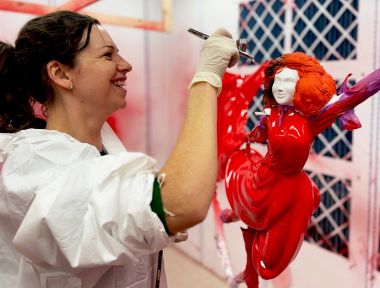
Unlike solid plaster or concrete, fibreglass can be manufactured as a hollow shell or applied as a protective coating over a lightweight sculpted core. This means it's possible to create large, detailed objects without the weight associated with many traditional materials. Fibreglass can also be finished to resemble almost anything, from stone and metal to realistic food, animals and cartoon characters. The material provides the structure, while skilled prop makers paint finishes that create the hyperrealistic appearance.
Why Is Fibreglass Such a Popular Material for Props?

There are several reasons why fibreglass is widely used in professional prop making.
1. It's Strong but Relatively Lightweight
One of the biggest advantages of fibreglass is its strength-to-weight ratio.
Imagine creating a giant sculpture of a chocolate bar. If it were made from solid plaster or concrete, it would be incredibly heavy, which makes transportation and installation a real nightmare. And that's before considering whether the floor or display surface could even support that kind of weight. A fibreglass version, on the other hand, can achieve exactly the same visual effect with a much lighter structure. This is particularly useful for large promotional props, exhibition displays and installations that need to be transported between locations.

Of course, large fibreglass props may still need internal metal frameworks or secure fixings to keep them stable and safe. (In fact, we rarely use just one material when making our props. It's usually a combination of materials, each chosen for its particular properties, that gives us the best result.)
2. It Can Be Made Into Almost Any Shape

Fibreglass is incredibly versatile when it comes to creating unusual shapes. It can reproduce smooth curves, intricate textures, complex characters and oversized versions of everyday objects. A prop maker can sculpt an original shape from polystyrene or clay, create a mould and then produce a fibreglass casting.

Alternatively, fibreglass can be applied directly over a prepared polystyrene sculpture to create a tougher exterior. Both techniques make it possible to produce objects that would be difficult to manufacture using conventional methods.
3. It's Durable and Suitable for Repeated Use

Commercial props often need to withstand more than simply sitting on display. They may be transported between events, handled during installation or exposed to visitors in busy retail environments. Fibreglass provides a hard-wearing surface that can be more resistant to everyday knocks and damage than uncoated polystyrene. This makes it a practical choice for props intended for repeated use.

However, durability depends on how the prop is constructed. A decorative sculpture isn't automatically suitable for climbing, sitting or leaning on. Interactive props need to be specifically designed for those loads.
4. It Can Be Used to Make Multiple Identical Props

Another major benefit of fibreglass is its suitability for repeat production. If a retailer needs identical promotional sculptures for 20 different stores, creating each one individually could be time-consuming. Instead, a master sculpture can be used to create a mould, allowing multiple fibreglass copies to be manufactured.

Fibreglass moulding is particularly useful for retail campaigns and branded installations where consistent size, shape and appearance are important. Although creating the mould involves an initial cost, it can make producing multiple identical props more efficient.
Where Are Fibreglass Props Used?

Fibreglass props are used across a wide range of industries, often in places where you might not realise they're made from fibreglass.
Retail and visual merchandising: Giant product replicas, seasonal window displays and branded sculptures help shops attract attention and create memorable customer experiences.
Exhibitions and events: Large promotional objects, themed displays and photo opportunities can help brands stand out in busy environments.
Film, theatre and themed attractions: Fibreglass can be used to create character sculptures, scenic elements and realistic replicas that need to be both detailed and durable.
Outdoor installations: With suitable construction, protective coatings and secure fixings, fibreglass can be used for outdoor sculptures and promotional displays.
Real Examples of Fibreglass Props
At Spur Creative, we've used fibreglass to create everything from giant promotional sculptures to detailed replicas for retail environments. Here are some examples that show just how versatile the material can be.
Giant Percy Pig for M&S

For the roof of an M&S store in Stevenage, we created a four-metre-high Percy Pig sculpture. We carved the original shape from polystyrene, laminated it with fibreglass and then removed the polystyrene from inside to reduce the weight. An internal metal framework provided the necessary structural support, while specially designed lifting points allowed the sculpture to be craned into position.

This project is a great example of how fibreglass can help us create enormous props without making them unnecessarily heavy.
See our giant Percy Pig project.
Liverpool FC Liverbird Sculpture

For Liverpool FC's Anfield megastore, we created a large Liverbird sculpture designed to look like cast metal.
The sculpture was moulded and cast in fibreglass, with an internal steel structure supporting the wings. Specialist painting techniques gave it a convincing metallic finish without the weight of a solid metal sculpture.

It's a great example of how fibreglass can replicate the appearance of a completely different material.
See our Liverpool FC Liverbird project.
Are Fibreglass Props Always the Best Choice?

Not necessarily.
For short-term indoor displays, lightweight polystyrene props may be perfectly suitable and more economical. For projects requiring a harder surface, repeated use, detailed moulded components or outdoor durability, fibreglass may offer significant advantages. In many cases, the most effective solution is to combine materials, using polystyrene for the main sculpted shape and fibreglass for the protective outer coating.
The best approach depends on the prop's size, location, intended lifespan and budget.
Looking for Bespoke Fibreglass Props?

Whether you're planning a giant promotional sculpture, a retail window display or an exhibition centrepiece, choosing the right materials and manufacturing techniques is essential.
At Spur Creative, we specialise in creating bespoke props that combine creative design with practical construction.
If you've got an idea you'd like to bring to life, explore our fibreglass prop-making services or get in touch to discuss your project.